Stock goes missing, nobody knows when
The count comes up short at stocktake. The footage exists, but by then it is thousands of hours deep, and often already recorded over.
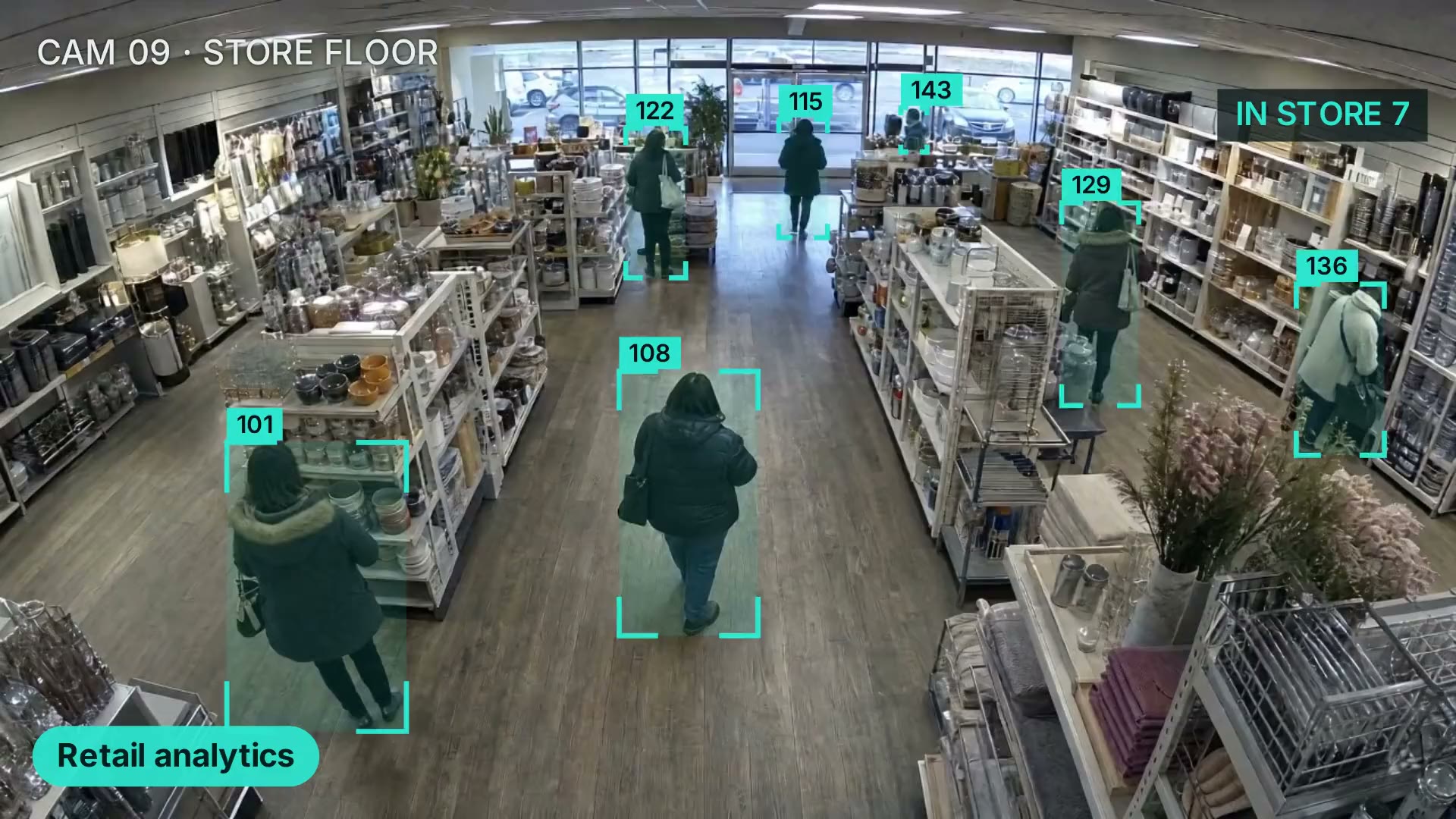
Illustration. Footage and figures are simulated.
Four things we hear on almost every site visit.
The count comes up short at stocktake. The footage exists, but by then it is thousands of hours deep, and often already recorded over.
A helmet not worn, a restricted area walked into. A supervisor cannot be in two places, so the gap shows only once something has gone wrong. Then an auditor asks for proof, and there is none.
A counter unmanned, a line stopped, a bay sitting idle. You find out when a customer complains. Until then the only answer is a supervisor walking the floor.
Out of stock, misplaced, or never put back. Every customer who walks away costs a sale that never shows up in any report.
It runs on the CCTV already installed at your site. Each location is surveyed first, because angle, lighting and recorder access decide what can actually be read.
The model is tuned on footage from your own cameras, in your own lighting and layout. That is what the pilot is for, and it is why the system reads your site better the longer it runs.
When something worth attention happens, it is kept as a record: the time, the camera, a short clip, and the context around it.
Your staff review a short queue instead of hours of footage. The decision stays with them, and their review is recorded alongside the event.
Intelligent Real-time Inspection System, built by PackVision. Half a minute on what it reads, and what it hands to your team.
Illustration. Footage and figures are simulated.
The largest cost in most camera projects is replacing the cameras. That cost does not apply here.
Staff stop watching screens and start handling the few things that need a human. The same team covers more ground.
Every event leaves a record with its evidence attached, ready when a manager, an insurer, or an investigation asks what happened.
Start with one location. Add more when it earns its place, without rebuilding what is already there.
No. PackVision is built to run on the cameras already installed at your site. That is the point of it.
Usually, but we survey the site before saying yes. Camera angle, lighting, image quality and access to the recorder all decide what can be read reliably. If a camera cannot give us something useful, we will tell you rather than sell you a result it cannot deliver.
Fewer things than a ready-made catalogue, and that is deliberate. What we set up is tuned to your site and to the outcomes you name: a counter left unattended, someone in an area they should not be in, a queue that has grown too long. We agree those outcomes with you before the pilot, and we tell you plainly which ones your cameras can support and which they cannot.
That is what the pilot is for. We start at one location, agree beforehand what success looks like, and measure it. If the cameras there cannot give us what the outcome needs, we will say so and you stop. We would rather lose a pilot than sell a result a camera cannot deliver.
Yes. A unit is installed on site so the processing happens where the cameras are. What does not change is the cameras themselves.
We do. The unit on site belongs to us and is included in the subscription. We replace it when it ages, and when a new detection needs more than it can run. You do not buy it, and you do not maintain it.
In most cases the money is already being spent: on staff time watching screens nobody can watch fully, and on losses written off as a cost of doing business. This is a monthly subscription rather than a purchase, so it usually sits in the operating budget instead of needing capital approval. You start with one site and add more when it earns its place. The figure follows how many cameras you have and what you want watched, which is why it comes after we survey the location.
Processing happens on site. What travels is the record of an event, not a continuous stream of your footage.
No. It changes what they spend their time on. The system prepares what is worth looking at; the judgement, and the decision, stay with your people.
It depends on the site and how the existing cameras are set up. The survey comes first, and it tells us the honest answer for your location.
Not necessarily. Processing happens on the unit at the site, not in the cloud, so a camera keeps being read even when the connection drops. What needs a connection is sending the event out and letting you look in from elsewhere. For remote locations we look at this during the survey, and sometimes the answer is a local power and connectivity fix rather than a bigger subscription.
That is a real pattern, and it is one of the first things we ask about during a survey. Keeping the camera and the unit on a small independent supply is usually cheaper than people expect, and we will tell you if your site needs it. What we will not do is pretend a system that is switched off can still see.
Yes, and that is the point of it. Sites are added one at a time, and once a site is connected it appears alongside the others rather than in an app of its own.
Yes. Events can be sent to a messaging app, and who receives what is set per site. The aim is a short queue somebody actually reads, not a stream of notifications that gets muted within a week.
Usually not, but it is one of the things the survey checks. What matters is whether the recorder will give us a stream we can read. If it will not, we say so before anything is signed.
That is set with you, because it drives both storage cost and your own obligations over the data. The original recordings stay on your existing system. What we keep is the events and their evidence, for the period you choose.
The unit is ours, so it comes back to us. Your cameras and your own recordings are untouched and remain entirely yours, because they were never ours to begin with.
The model for your site is tuned on your footage, for your site. If we ever wanted to use anything from your sites beyond that, we would ask you first.
The cameras and the footage remain yours. We work within what your existing installation already covers. We do not use face recognition to match people against a watchlist: that is biometric data under Indonesian law, and the obligation would land on you as the site owner, not on us. We are glad to go through all of this with whoever handles it on your side.
Send your address and we will get back to you to arrange a consultation.